
You started walking because everybody told you to. Thirty minutes a day, good for the heart, good for the mood, good for the back. Then your body sent the bill. Twenty minutes in, your low back starts to tighten. Your hip catches on the outside. By the time you get home your neck and shoulders are up around your ears and you cannot figure out why a walk would do that to a neck. Nothing is torn. Nothing shows up on a scan. It just hurts, and it hurts in three places that do not seem connected. They are connected. That is the whole story.
Walking Is One Movement, Not Three
Here is what most people never get told. Your back is wrapped in a broad, tough sheet called the thoracolumbar fascia. Your big back muscle on one side, the latissimus, anchors into it from above. Your glute on the opposite side anchors into it from below. When you walk, the right arm swings forward with the left leg, and the research on this is clear: the lat and the opposite glute fire together through that sheet, and they fire harder the faster you walk. Your arm swing is not decoration. It is how your upper body winds up the fascia so your hip can push off. Neck, back, hip. One elastic system, one movement.
I wrote the full explanation of how fascia works in my article on what fascia is and why it matters. The short version is that fascia is supposed to glide. When it stops gliding, everything attached to it has to work around the stuck spot, and the places that work the hardest are the places that hurt.
Where The Chain Breaks
Start at the hip, because that is where it usually starts. You sit eight hours a day. The hip flexors in the front of your hip spend those hours shortened, and the fascia around them sets like that. Now you go for a walk and your leg cannot swing back behind you the way it should. Your stride shortens. Studies on walking show that when the hip cannot extend, stride length drops and the pelvis tips forward, and when a hip flexor program restores that extension, stride length comes back. Your body does not accept a short stride without a fight, so it steals the missing motion from the low back. Every step, your lumbar spine twists and arches to cover for a hip that will not open. Twenty minutes of that and your low back is on fire.
Meanwhile your glute, the muscle that was supposed to power the push off, has gone quiet, because the hip flexor in front of it has been holding it down all day. The piriformis and the small muscles on the side of the hip pick up the slack, and that is the catching, burning pain on the outside of the hip or deep in the cheek that gets worse the farther you go. If it runs down the leg, read my piece on sciatica relief in Greenville, because the same muscles are usually the culprits.
Now the neck. Watch anyone with low back or hip pain walk and you will see it: the arms stop swinging. The body is guarding, so it locks the trunk and shuffles. With no arm swing the fascial chain never winds up, the push off gets even weaker, and the upper traps and the levator, the muscles that run from your shoulder blade to your neck, take over the job of holding your upper body steady with every step. Add a forward head from looking at a phone and you have a neck that aches after a walk even though the walk never asked anything of the neck. The pattern is the same one I describe in my neck pain article, just triggered by your feet instead of your desk.
The place that hurts is rarely the place that is stuck. The hip stops moving, the back and neck pay the bill.
What Myofascial Release Actually Is
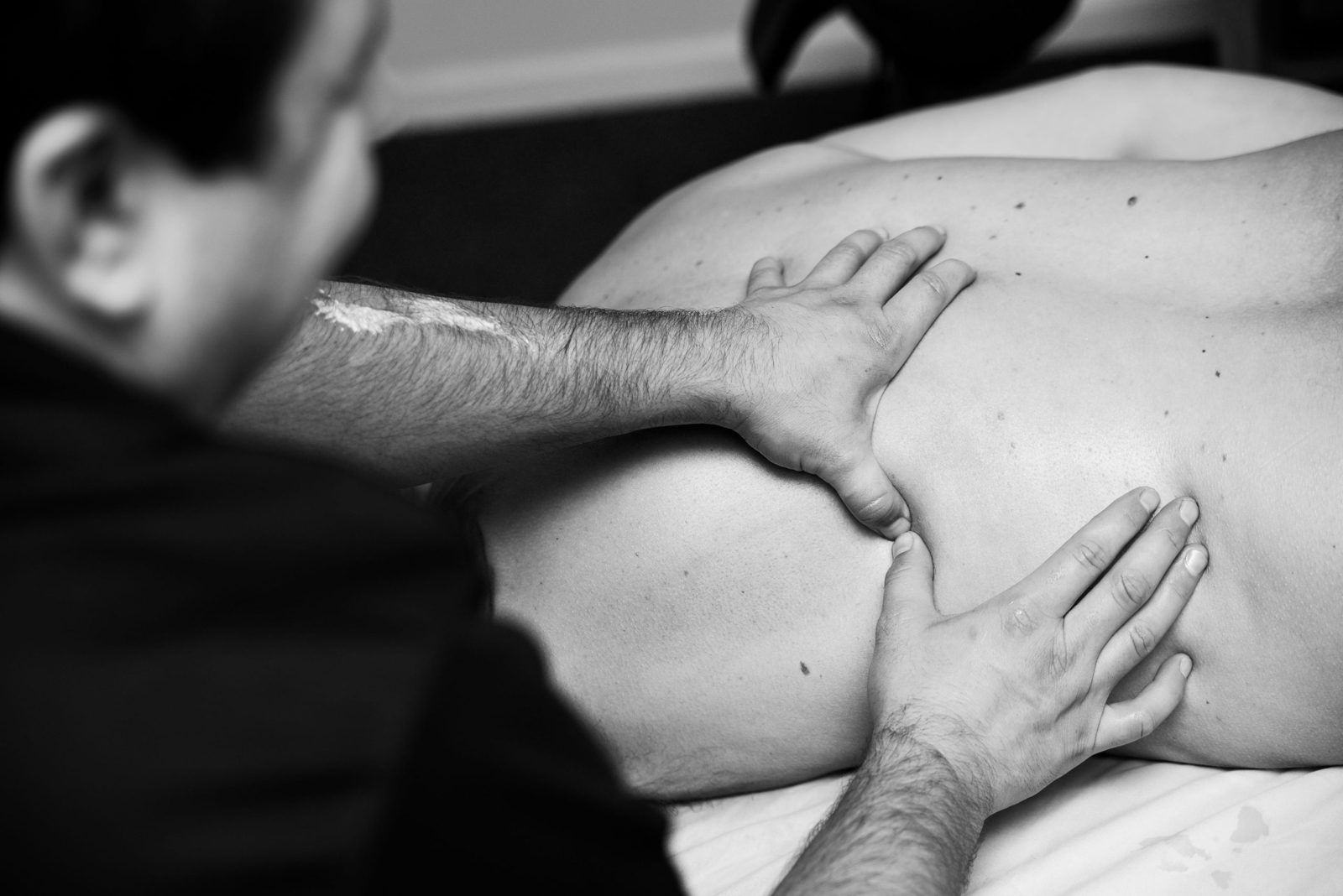
Myofascial release is slow. That is the first thing patients notice, because they expect the deep, fast, grind it out pressure they have had elsewhere. Fascia does not respond to speed. It responds to sustained pressure held long enough for the tissue to let go, usually somewhere between ninety seconds and a few minutes on one spot, with the pressure angled along the line the fascia runs, not straight down into it. I find the stuck spot, I load it, and I wait. You feel it soften under my hands, and then the muscle that was being held down gets to move again. I go deeper into the technique on my myofascial release page and in why your muscles will not let go.
The research backs this up. A 2024 analysis of ten controlled trials found myofascial release reduced chronic neck pain, and a review of eight trials found it improved both pain and physical function in chronic low back pain. The honest caveat is that these are modest, measured effects, not miracles. In my office the difference between a study and a result is that I am not releasing a random spot for a protocol. I am releasing the spot your walk told me about.
The Walking Test I Do In My Greenville Office
Before I put my hands on anyone with this pattern, I watch them walk. Down the hall and back. I am looking at four things: which arm does not swing, which hip does not extend behind the body, which way the pelvis dips, and where the head sits over the shoulders. Those four tell me where the chain is stuck before you have described a single symptom. Then I confirm it with my hands. Nine times out of ten the stuck link is the front of the hip and the fascia across the low back, and the neck is the last stop on the line, not the first.
So the session usually runs in that order. Hip flexors and the fascia over the front of the hip first, so the leg can swing back. The thoracolumbar fascia and the glute next, so the push off comes back online. Then the upper back, traps, and the neck, which by that point have already started to let go on their own, because the job they were covering for is being done again downstairs. Patients walk out of the office and the first thing they notice is their arms are swinging.
What To Do Before You Come In
Keep walking, shorter. If twenty minutes lights you up, walk twelve, twice. Pain that shows up at a predictable minute is a tissue tolerance problem, not a reason to stop. Second, stop stretching harder. I explained in why stretching alone will not fix tight muscles that a stuck fascial sheet does not care how long you hold a hamstring stretch; you are pulling on a rope that is tied to a post. Third, be careful with the foam roller on the outside of your hip. Rolling the IT band for ten minutes is mostly just bruising it. If you want to roll something, roll the front of the hip and the glute, lightly, and read how to use a foam roller properly first.
And if the pain started with a fall, comes with numbness that does not fade, or wakes you at night and will not let you back to sleep, that is a different conversation and you should have it with someone who can image you. For everyone else, the ER is the most expensive place in town to learn that your walk hurts because your hip stopped moving. Patients drive from across the Upstate to have me find that in one visit. Your first appointment is online, about thirty seconds to book, and the walk home afterward is the first test.