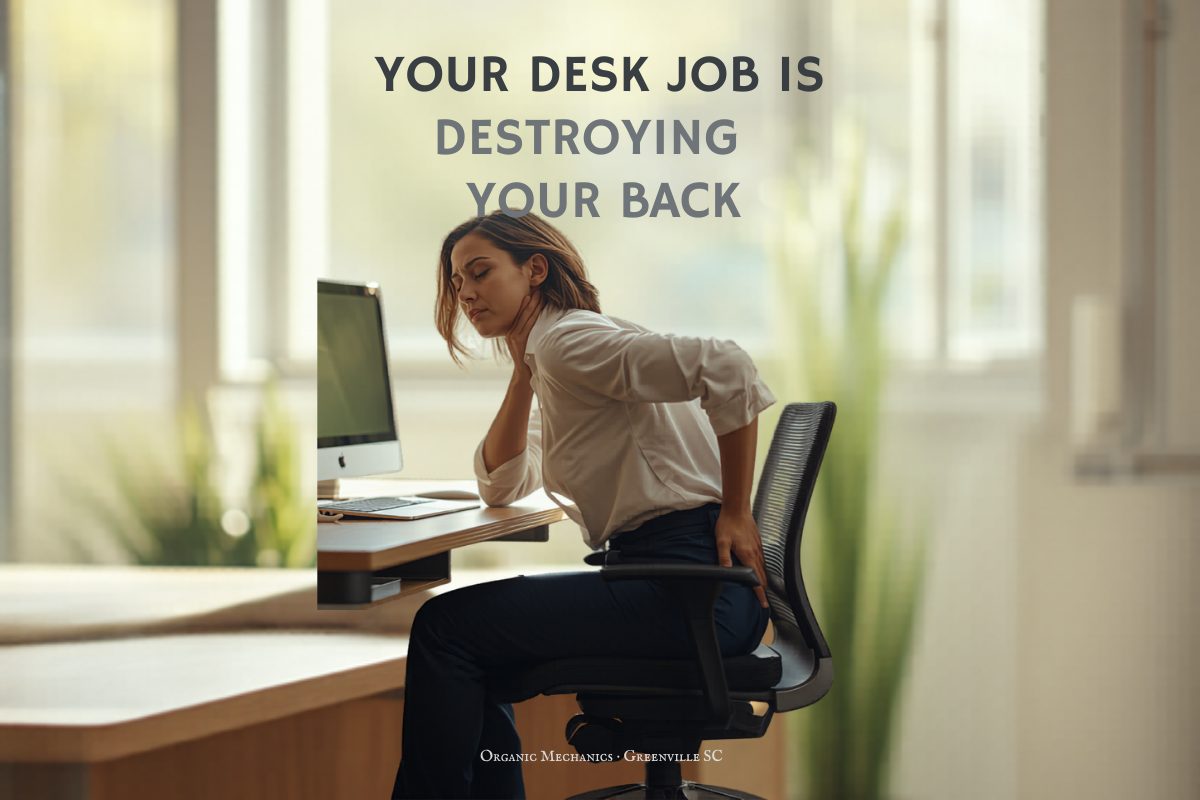
You sit down at 8 a.m. You get up at noon to eat something. You sit back down. By 5 p.m. your lower back aches, your shoulders are up by your ears, and your neck feels like someone welded it in place. This is not a mystery. This is what eight hours of sitting does to the human body every single day.
The frustrating part? Most advice tells you to stretch or buy a better chair. Those things help on the margins. But the damage sitting does to your muscular system runs deeper than a standing desk can fix.
What Sitting Actually Does to Your Muscles
When you sit, your hip flexors shorten. Not a little — a lot. After years of desk work, the psoas and iliacus become chronically contracted, pulling your pelvis into an anterior tilt that compresses your lumbar spine. That is the direct mechanical cause of most desk-worker lower back pain.
At the same time, your glutes shut off. They are not working against gravity when you sit, so they weaken and stop firing when you need them. This is called gluteal amnesia, and it forces your lower back to pick up the stabilization load your glutes should be carrying.
Up top, the pattern is just as predictable. Your pectorals and anterior deltoids shorten from rounded shoulders. Your upper trapezius and levator scapulae work overtime to hold your head up while it drifts forward over your screen. This is tech neck — and it adds up to 60 extra pounds of strain on your cervical spine.
But the damage sitting does to your muscular system runs deeper than a standing desk can fix.
Why Stretching Is Not Enough
Here is the part most people miss. When muscles are chronically shortened from sitting, they develop trigger points — hyperirritable knots that maintain the muscle in a contracted state. Stretching a muscle with active trigger points is like trying to stretch a rope with a knot tied in the middle. The knot does not release. The healthy tissue on either side takes all the stretch force, and you end up feeling looser for about an hour before the trigger points pull everything tight again.
Neuromuscular therapy deactivates those trigger points first. Then stretching actually works because the muscle can lengthen fully.
The Desk Worker Protocol
At Organic Mechanics, I see desk workers almost every day. The treatment follows a logical sequence because the dysfunction follows a predictable pattern:
First, I release the hip flexors — the psoas and iliacus — to restore neutral pelvic alignment. This immediately reduces lower back compression. Then I address the quadratus lumborum, which has been overloaded compensating for weak glutes and tight hip flexors.
In the upper body, I release the pectorals and anterior deltoids that are pulling the shoulders forward, then work the posterior chain — the rhomboids, middle trapezius, and deep neck flexors — so they can actually hold you upright without fighting against shortened anterior muscles.
The suboccipital muscles at the base of the skull get specific attention because they are the number one source of tension headaches in desk workers. When your head sits forward of your shoulders all day, these small muscles work constantly to keep your eyes level.
Your Wrists and Forearms Are Part of It Too
If you type for hours, your forearm flexors and extensors accumulate trigger points that refer pain into the wrists and hands. Many people are told they have carpal tunnel syndrome when they actually have forearm trigger points mimicking carpal tunnel. The difference matters because one requires surgery and the other requires neuromuscular therapy.
I assess both possibilities and treat the muscular component directly. If it is true carpal tunnel, I will tell you that too.
Working From Home Made It Worse
Since 2020, I have seen a significant increase in desk-related pain. Working from home on laptops, kitchen tables, and couches stripped away whatever ergonomic support offices provided. Dining chairs do not have lumbar support. Laptop screens sit a foot below eye level. And without the natural movement of commuting, walking to meetings, or going out for lunch, people sit even more continuously at home than they did in the office.
If your home setup involves a laptop on a flat surface, you are guaranteed to develop forward head posture and upper back strain. I treat this pattern constantly and provide ergonomic recommendations as part of the session.
How Often Desk Workers Need Treatment
If you are currently in pain, I typically recommend weekly sessions for three to four weeks to break the cycle, then transition to every two to four weeks for maintenance. The sitting is not going to stop, so periodic maintenance keeps the muscular patterns from rebuilding to the point of pain.
Between sessions, I give you specific stretches and positioning cues that actually matter for your pattern — not generic advice. The FAQ page covers what stretches complement desk-worker massage, standing desk considerations, and how often office workers should get neuromuscular therapy.